

Stack Automation by Quali, the infrastructure automation platform co-developed with Cisco and sold exclusively through Cisco, has reached general availability. The pitch aims at the gap between buying AI infrastructure and using it: deployments that traditionally consume six to twelve weeks of manual assembly should, the companies say, come up in hours, with Cisco Validated Designs baked in as deployable blueprints rather than PDF homework assignments.

The platform pairs Quali’s automation and agentic AI engine with Cisco Validated Designs and Cisco security practices, and it integrates with Cisco Intersight and Cisco Nexus Dashboard to cover Day 0 and Day 1 planning through deployment. Quali also says Stack Automation will become part of Cisco Cloud Control, the unified AgenticOps operations platform Cisco introduced in June, tying the deployment engine into the same console where human operators and AI agents already work.
“Enterprise infrastructure has reached an inflection point, and the teams that will win are the ones that treat the infrastructure layer as a strategic asset rather than an operational constraint,” said Lior Koriat, CEO of Quali.
A Catalog of Validated Stacks
The front door is the Solutions Hub, a catalog of validated blueprints spanning networking, security, observability, virtualization, AI frameworks, and enterprise applications. At GA, the catalog includes Cisco Nexus Dashboard, Cisco Intersight, Catalyst Center, and Identity Services Engine alongside Splunk, Red Hat OpenShift, NVIDIA NIMs, VMware, Qumulo, and Veeam, with additional Cisco and partner solutions continuing to roll out.
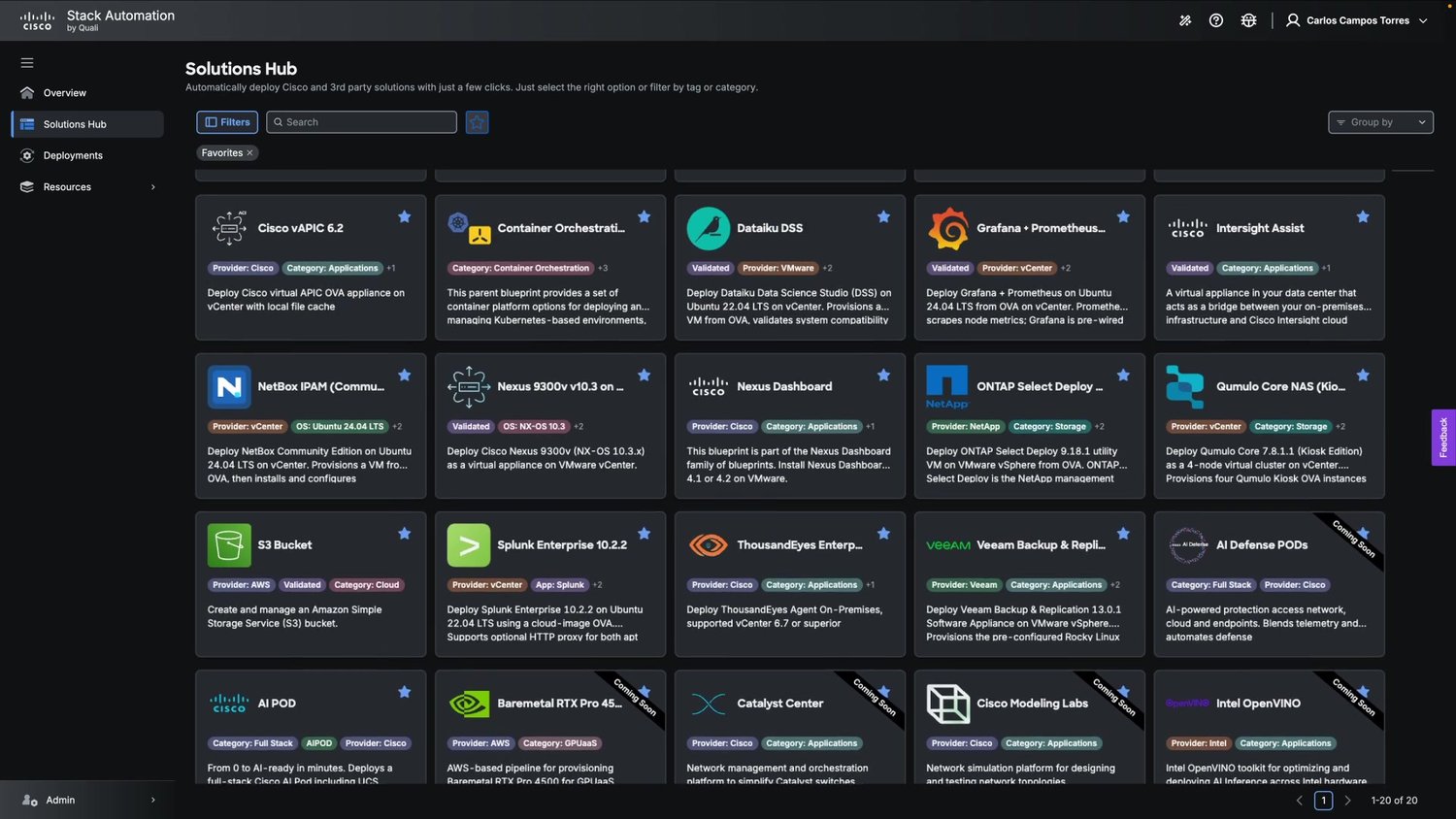
Under the hood, the platform orchestrates standard infrastructure as code, with support for Terraform, Ansible, Helm, Python, and Shell, so automation assets teams already maintain slot into blueprints rather than getting rewritten. It also picks up where publishing a validated design leaves off. Reference architectures like the NetApp and Cisco FlexPod AI designs tell customers what to build; Stack Automation is the machinery that builds it.
“Customers should not have to spend weeks assembling infrastructure before they can begin putting AI to work,” said Jeremy Foster, Senior Vice President and General Manager, Cisco Compute. “This can take customers from rack to application in hours, giving them a faster, more consistent and more secure path to deploying AI and mission-critical infrastructure at scale.”
Day 2 Is Where It Gets Interesting
Cisco’s two-minute demo video tells the operational story. A deployed AI POD in the demo surfaces service health, drift detection against the original blueprint, and a running cost estimate of $3.20 per day with $0.40 per day in flagged potential savings, all sitting on a live inventory of the stack underneath: a Cisco UCS X9508 chassis, NVIDIA L40S GPUs, Nexus 93600 switching, NetApp AFF C800 storage, and a Red Hat OpenShift cluster.
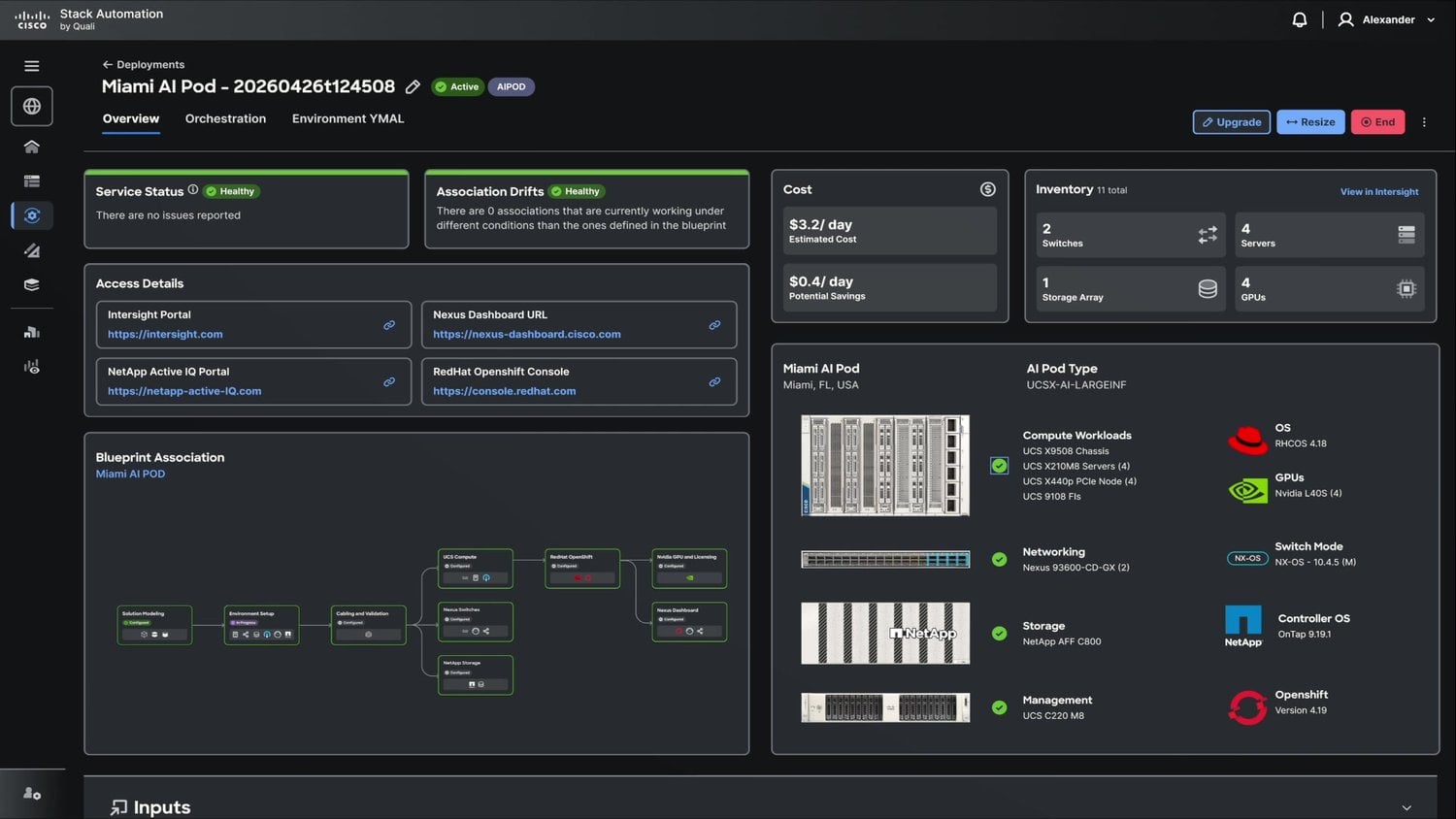
That Day 2 layer, continuous compliance, drift detection, and cost governance carried forward after the deployment finishes, is the part most infrastructure automation quietly skips, and it is where the platform will earn or lose its keep in production.
Agentic Design, Tiers, and Timing
For teams that outgrow the catalog, the Blueprint Designer adds an agentic copilot that assembles and modifies blueprints conversationally. In the demo, it works over a visual canvas to extend a Catalyst 8000V blueprint with preflight check and snapshot steps, the kind of glue work that normally lands in a backlog.
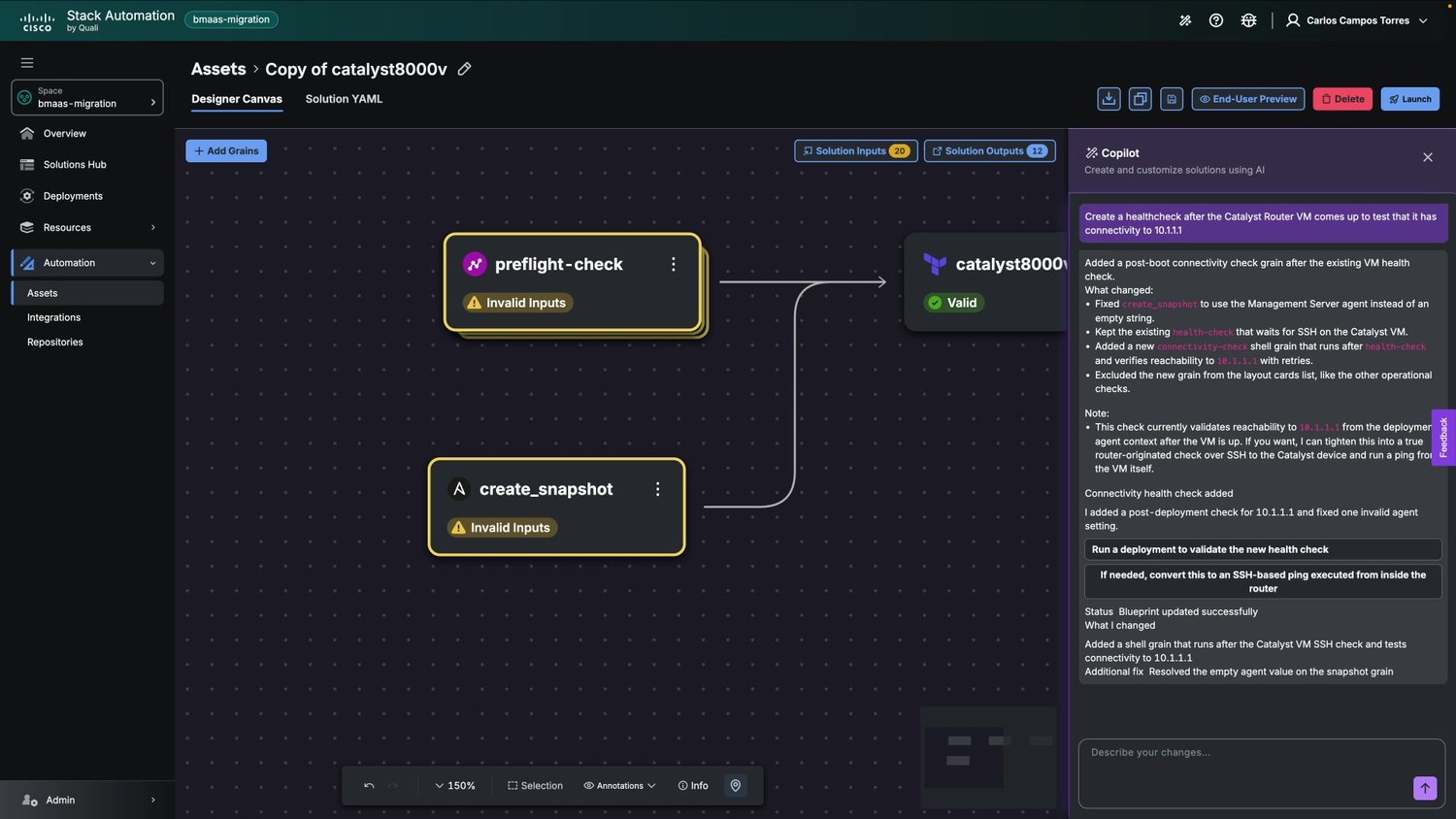
Stack Automation sells in two tiers: Essentials covers standard software deployments, while Advantage adds the Blueprint Designer, GitOps workflows, advanced customization, and the agentic design capabilities. The platform is orderable now through Cisco, and Cisco says support for AI PODs as deployable full stack solutions reaches general availability in October 2026.



 Amazon