

The BLUETTI Elite 400 is a 3.84 kWh portable power station intended for home backup, remote work, camping, and other applications where dependable power may not be nearby. Its 3,840Wh LiFePO₄ battery provides enough stored energy to do more than charge phones and laptops, with capacity to run equipment such as refrigerators, networking equipment, desktop computers, televisions, and other essential devices.

Key Takeaways
- 3,840Wh on wheels: the Elite 400 is the first BLUETTI we have tested with integrated wheels and a telescoping handle, at 85.98 pounds (39kg) and 17 x 11.34 x 19.29 inches with the handle retracted, 41.02 inches with it extended.
- 6ms to battery under a 740W load: with a Dell workstation on the output, the Quarch capture showed a 6ms transfer from utility to battery and 14.8ms back, both inside BLUETTI’s 15ms rating, with no disruption to the workstation across two cycles.
- 3.07kWh delivered, 3.96kWh to refill: the blower-fan discharge pulled 3.07kWh from the AC outlets before shutdown, 80 percent of the rated capacity, and a 0 to 100 percent recharge drew 3.96kWh from the wall.
- 2,600W continuous, 1,800W from the wall: four AC outlets share the inverter’s 2,600W limit, AC input tops out at 1,800W, which is also the most the grid can feed through the unit to connected loads, and solar adds up to 1,000W for a 2,800W combined input ceiling.
- Fewer ports than the Elite 300: the TT-30 RV outlet and 12V/30A DC output are gone, leaving two 100W USB-C ports, two 15W USB-A ports, and a 120W cigarette-lighter socket beside the four AC outlets, at $1,399 with a five-year warranty.
The larger battery also suits users who need equipment to stay operational during an outage, not just long enough for a controlled shutdown. Actual runtime will depend on the connected load, inverter losses, operating temperature, and cell health.
The inverter delivers up to 2,600W of continuous AC output at 120V, allowing the Elite 400 to support a mix of smaller devices or individual high-draw appliances, as long as the total connected load stays within its output limit. Networking equipment, lighting, and chargers leave considerably more headroom than a microwave, electric kettle, space heater, or other resistive loads.
BLUETTI lists a separate 5,200W surge rating and a 3,900W Power Lifting rating. These figures serve different purposes that are important to understand; the surge rating applies to brief load demands. Check BLUETTI’s guidance on supported loads and operating restrictions before use. Neither figure increases the unit’s continuous 2,600W rating.
The connection layout includes four NEMA 5-20R AC outlets, two 100W USB-C ports, two 15W USB-A ports, and a 120W cigarette-lighter socket. This provides nine outputs for household equipment and smaller electronics. The USB-C connections support compatible laptops and tablets, letting you charge them without using an AC outlet or their wall adapters, and eliminating an extra AC-to-DC conversion.
Solar charging supports up to 1,000W, with an input range of 12 to 60V and a maximum current of 20A. Combined AC and solar charging increases the advertised input ceiling to 2,800W. That gives the Elite 400 several ways to replenish its larger battery, although actual solar input depends on the panel configuration, sunlight, temperature, and other conditions.
Wi-Fi and Bluetooth connectivity let you access the unit through the BLUETTI app. The pass-through charging feature lets connected equipment run while the unit receives external power. The advertised 15ms UPS transfer time adds another potential use for home-office and networking backup, but compatibility is best confirmed with the equipment you plan to connect.
BLUETTI Elite 400 Pricing and Warranty
The Elite 400 includes a five-year warranty and sells for $1,399 USD at the time of review. Consider available bundles and charging accessories separately when evaluating the total cost of a solar- or vehicle-based setup.
For buyers comparing models within the Elite lineup, the important question is how much additional runtime they need. The Elite 400’s larger battery may justify its size and weight for longer outages, while users with shorter backup requirements may find a smaller unit easier to store and transport.
BLUETTI Elite 400 Specifications
The figures below come from BLUETTI’s US product page for the Elite 400 as of October 31, 2026, and the comparisons later in the review use the same page for the Elite 300. The printed manual lists the chassis at 427 x 286 x 490mm and omits the surge and storage temperature figures, so where the two differ, we use the product page throughout.
| Specification | BLUETTI Elite 400 |
|---|---|
| Battery | |
| Model | Elite 400 |
| Battery Capacity | 3,840Wh |
| Battery Chemistry | LiFePO₄ (Lithium Iron Phosphate) |
| Power Output | |
| Continuous AC Output | 2,600W Max (120V, 50/60Hz) |
| Surge Power | 5,200W |
| Lifting Power | 3,900W |
| Output Ports | |
| AC Outlets | 4x AC outlets, 2,600W Max. combined (NEMA 5-20R receptacles on our unit) |
| USB-A | 2x 15W Max Each, 30W Total |
| USB-C | 2x 100W Max Each |
| 12V Output | 1x Cigarette Lighter 120W Max |
| Charging | |
| AC Input | 1,800W Max., 120V (IEC C14 inlet) |
| Solar Input | 1,000W Max., 12 to 60V, 20A Max. |
| Combined AC + Solar Input | Up to 2,800W |
| General | |
| Dimensions | Without Handle 17 × 11.34 × 19.29 in (432 × 288 × 490 mm) With Handle 17 × 11.34 × 41.02 in (432 × 288 × 1,042 mm) |
| Weight | 85.98 lbs / 39 kg |
| Storage Temperature | 14℉ to 104℉ / -10℃ to 40℃ |
| Discharging Temperature | -4 °F to 104 °F / -20 °C to 40 °C |
| UPS Switching Time | 15ms |
| App Connectivity | Wi-Fi and Bluetooth |
| Warranty |
5 Years |
Build and Design
The BLUETTI Elite 400 takes a taller, rolling approach to portability compared with other units, and it’s the first BLUETTI unit we have seen with integrated wheels for transport. Its enclosure measures 17 × 11.34 × 19.29 inches (432 × 288 × 490 mm), with the handle retracted. Extending the handle increases the overall height to 41.02 inches (1,042 mm). The Elite 400 also features rubber pads on the rear to let it lay flat for storage or transport without risking a tip-over.

Compared to the Elite 300’s 14.41 × 12.01 × 11.71 in (366 × 305 × 297.5 mm), the Elite 400 chassis is about 2.5 inches wider, 3/4 inch shallower, and 7.6 inches taller while still carrying an extra 800Wh of capacity. Another noticeable difference is that the Elite 300 features vents on the front and rear, while the Elite 400 has moved to left- and right-side vents that are also removable for cleaning.

At shy of 90 pounds, the Elite 400 is a fairly hefty piece of battery kit. The wheels and extending handle are therefore a significant part of its design, particularly for moving it between storage and the equipment it powers, or from site to site. One consideration, though, is the surface this unit will roll on, as the wheels aren’t very wide or tall, so surfaces like gravel or soft ground may be less than ideal, especially given the weight.
Rolling mobility helps around a home, garage, or our lab, but lifting remains a factor. Although this unit is hefty, it’s lighter than some of its competition for its capabilities and capacity, with BLUETTI claiming up to 35% lighter than others.

The four NEMA 5-20R outlets provide connections for standard household equipment and compatible 20A plugs. Their combined output remains subject to the inverter’s 2,600W limit; the receptacle type does not provide that amount of power independently at each outlet.
BLUETTI’s documentation does not say how the four outlets are wired, so we checked, and they are tied together behind the panel on a shared line and neutral, with the inverter’s 2,600W limit as the only ceiling on their combined draw. A NEMA 5-20R receptacle is rated for 20A, which is 2,400W at 120V or 1,920W under the 80 percent rule for continuous loads, and we found no per-outlet protection, so a single outlet could, in principle, be asked for more than its rating. Few plug-in devices draw that much, but keep any one heavy load under 1,920W continuous and spread the rest across the other outlets.
The smaller connections include two USB-C ports rated for up to 100W each and two USB-A ports rated for up to 15W each. The 120W cigarette-lighter socket provides a DC connection for compatible automotive accessories and portable equipment.

Compared with the Elite 300’s connection selection, the supplied Elite 400 specifications omit the dedicated TT-30 RV outlet and high-current 12V/30A connection. That makes connection requirements worth a close look, especially for users choosing between the two models for an RV or DC-powered installation. We detail the earlier model’s connections in our Elite 300 review. Though BLUETTI hasn’t given a reason for leaving these ports out of the Elite 400 selection, they aren’t positioning this unit with “RV Ready” marketing as they did with the Elite 300. Between the two units, it is a little surprising to see those ports on only one unit in the same product family, but we’ll try not to get too hung up on that.

AC charging uses an IEC C14 inlet and can draw up to 1,800W from the wall. BLUETTI’s product page lists no separate bypass rating, so that 1,800W input is the figure to plan around for what the grid can feed through the unit while it is plugged in; the inverter’s 2,600W applies to what the battery can deliver. On either side of the inlet, we can also see the grounding screw and 20 amp resettable circuit breaker.

Usability and Interface
The Elite 400 supports Wi-Fi and Bluetooth connectivity through the BLUETTI app. This lets you manage the unit from a phone, which is useful when the power station is under a desk, beside appliances, or away from the equipment you’re monitoring. The app also supports managing Wi-Fi power stations from anywhere and integrates severe-weather alerts to prioritize recharging the battery before a potential outage.

For everyday backup use, the most useful information is the battery’s state of charge, incoming power, connected load, and estimated runtime. These readings help users understand how changes in equipment consumption affect the available backup window. When using solar/PV input, the app can also show estimated monthly power savings.

The working and charging modes are also easy to access in the unit settings. The main differences in charging modes are heat and noise: silent charging is slower and doesn’t ramp the fans, turbo ramps up the fans to stay cool, and standard sits in the middle. You can also set a custom option to lower the max grid charging current if you are on a high-load circuit or an unstable source. Power lifting is also available in this same menu.

If you have used or owned another BLUETTI unit, this will probably look familiar, as the Elite 400 doesn’t seem to have any new app functionality we haven’t seen before.
Power Testing
The Elite 400’s 3,840Wh rating describes its nominal battery capacity. Delivered energy at the AC outlets will be lower because of inverter losses and the power required to operate the unit itself. Measuring that delivered energy provides a more useful basis for estimating runtime.
For discharge testing, we use a sizable blower fan to provide a consistent inductive load and place our power meter in the middle to measure output power before the unit powers down. We saw 3.07kWh on discharge before the battery completely depleted. This is quite a bit lower than the rated 3,840Wh. On a recharge cycle from 0% to 100%, we saw a total draw of 3.96kWh from the wall to completely recharge the battery.
For backup testing, we connected a Dell T2 workstation through our Quarch power analyzer, ran a benchmark that pulled roughly 740 W, and interrupted incoming AC power. The measured transition to battery operation was 6ms, well inside BLUETTI’s advertised 15ms rating and 2ms quicker than the Elite 300’s 8ms.

Restoring incoming power produced a 14.8ms transition back to utility operation, with a noisier waveform for a few cycles as the unit resynchronized to the line, which the capture below shows. Across two interruption cycles, the connected workstation was unaffected under load.
BLUETTI’s user manual says the UPS function is not intended for devices such as data servers or workstations that require a high-performance UPS. Our workstation rode through both transfers without a problem, but for a system where an interrupted shutdown would be costly, a dedicated online UPS remains the more conservative choice.

| Specification / Test | BLUETTI Elite 400 | BLUETTI Elite 300 | BLUETTI Elite 200 V2 |
|---|---|---|---|
| Rated Battery Capacity | 3,840Wh | 3,014.4Wh | 2,073.6Wh |
| Measured AC Energy Delivered | 3.07kWh | 2.67kWh | 1.91kWh |
| Measured Recharge Energy | 3.96kWh | 3.49kWh | 2.44kWh |
| Measured Transfer to Battery | 6ms | 8ms | Not measured |
| Measured Transfer to Utility | 14.8ms | 8.25ms | Not measured |
The extra capacity shows up in delivered energy: 3.07kWh against 2.67kWh for the Elite 300 and 1.91kWh for the Elite 200 V2, about 15 percent more usable energy than the Elite 300 for 27 percent more rated capacity. At the 740W workstation load from the backup test, 3.07kWh works out to a little over four hours against about 3.6 hours for the Elite 300, and at a 100W networking load the gap is roughly 30 hours against 27.
The Elite 400 also returns less of its rating than the smaller units: 80 percent of 3,840Wh against 89 percent on the Elite 300 and 92 percent on the Elite 200 V2, and with 3.96kWh drawn to refill it, round-trip efficiency lands near 78 percent.
Against that runtime, the Elite 400 asks for 28 more pounds (85.98 against 57.98) with wheels to carry them, a chassis that stands 7.6 inches taller on the same footprint class, two fewer connections (the TT-30 and 12V/30A outputs are gone, and the Elite 300’s 140W USB-C port becomes a second 100W port), 1,000W of solar input against 1,200W, and $1,399 against the $1,199 the Elite 300 listed at when we reviewed it in August. AC input is the same: 1,800W on both.
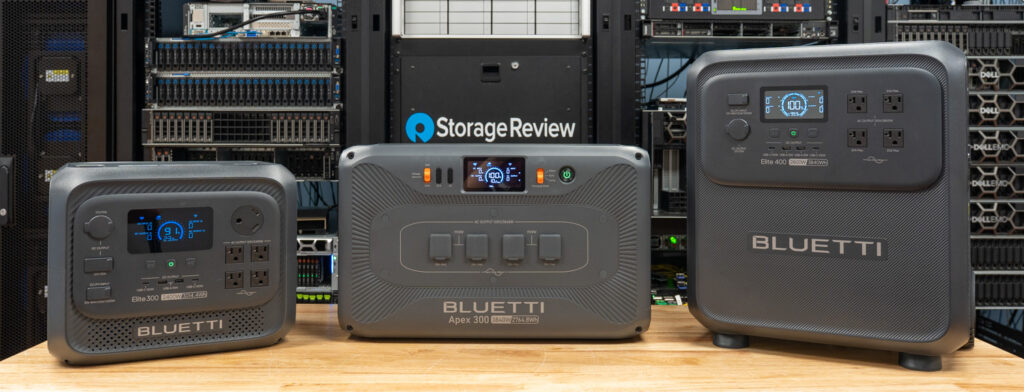
BLUETTI Elite 300, Apex 300, and Elite 400
Conclusion
The BLUETTI Elite 400 brings a larger battery and a different approach to mobility to the Elite lineup. Its 3,840Wh capacity, 2,600W continuous AC output, and integrated wheels make it a practical option for keeping household essentials, networking equipment, or a workstation running through an outage. The telescoping handle makes it easy to move the unit between storage and its operating location without carrying its full weight.
Backup testing went cleanly. With a Dell workstation drawing roughly 740W under load, we measured a 6ms transition to battery power and a 14.8ms transition back to utility power, both inside BLUETTI’s advertised 15ms. We observed no disruption to the workstation during either transition across the two cycles tested. The switch to battery was quicker than the Elite 300’s 8ms, while the return to utility was slower than its 8.25ms and noisier on the waveform; for the workstation used in this review, that difference did not cause an issue.
The physical design comes with its own considerations. At approximately 86 pounds (39 kg), the Elite 400 remains heavy when stairs, vehicle loading, or raised storage areas are involved. Its wheels make movement across solid surfaces easier, but their size and width are less suited to soft ground or gravel. The rolling enclosure is most useful around a home, garage, or workspace where a clear path is available.
The Elite 400 also makes some connection trade-offs compared with the Elite 300. It retains four household AC outlets and two 100W USB-C ports, but omits the TT-30 RV outlet and dedicated 12V/30A DC output. Buyers using those connections may find the Elite 300 better suited to their equipment despite its smaller battery. Also consider the 1,800W AC input ceiling when planning an always-connected installation, since that is what the wall can supply through the unit, and keep any single heavy load under the 1,920W continuous rating of one 20A outlet, because the four outlets share the 2,600W inverter without per-outlet protection.
At $1,399, the Elite 400 is a capable option for users who prioritize longer backup operation and the convenience of rolling the unit into place. It fits best as household or workspace backup on a single level, where the larger battery can be used without frequent lifting. The added capacity is useful, but measured energy delivery, connection requirements, and transport conditions should guide your choice between it and the smaller Elite models.


 Amazon